In the fast-paced world of digital transformation, businesses are increasingly turning to artificial intelligence (AI) to strengthen their information technology (IT) strategies. AI isnt just a buzzwordits a powerful enabler of smarter, faster, and more efficient operations. Whether it's automating mundane tasks, enhancing cybersecurity, or predicting business outcomes, AI is reshaping how companies approach their IT goals.
In this blog, well explore how AI can support and elevate IT strategies across various areas of business operations.
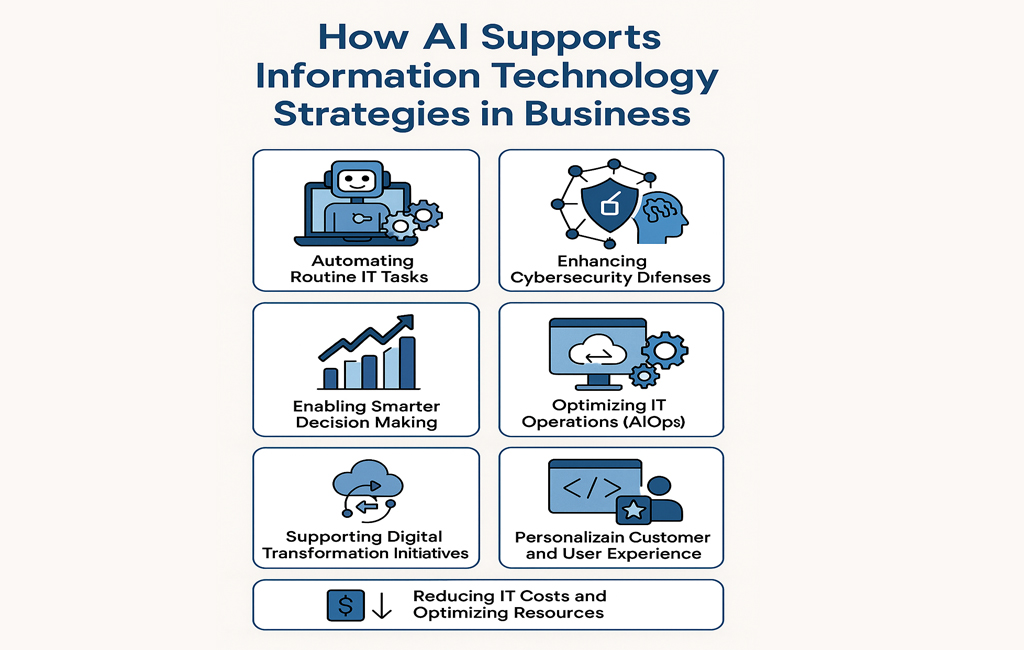
1. Automating Routine IT Tasks
One of the most immediate benefits of AI is its ability to automate repetitive and time-consuming IT tasks. From handling support tickets to managing server backups, AI-driven tools free up human IT teams to focus on strategic initiatives.
Examples:
AI Chatbots for help desks
Script-based automation for software updates
AI in DevOps to streamline CI/CD pipelines
2. Enhancing Cybersecurity Defenses
Cyber threats are evolving rapidly, and traditional security measures often fall short. AI brings proactive and predictive capabilities to the security landscape, helping businesses stay ahead of potential attacks.
How AI Helps:
Detects unusual activity or threats in real time
Uses machine learning to recognize new malware
Automates incident response and reduces false positives
3. Enabling Smarter Decision Making
Data is the lifeblood of modern businesses, but making sense of vast volumes of information requires intelligence. AI enables IT teams and business leaders to turn raw data into actionable insights.
Key Applications:
Predictive analytics to forecast market trends
Business intelligence tools enhanced with AI
Sentiment analysis to understand customer feedback
4. Optimizing IT Operations (AIOps)
AIOps - AI for IT operations is a game changer. It helps manage complex IT environments by automatically detecting, diagnosing, and resolving issues before they impact users.
Benefits:
Reduces system downtime
Improves service availability
Enhances user experience with faster problem resolution
5. Supporting Digital Transformation Initiatives
AI supports the broader goals of digital transformation by integrating seamlessly with emerging technologies like IoT, edge computing, and blockchain. It helps businesses modernize legacy systems and adopt agile methodologies.
Strategic Impact:
Faster time to market for digital products
Smarter integration of cloud and on-premise systems
Continuous improvement through AI-powered feedback loops
6. Boosting Software Development Efficiency
AI tools are now integral to the software development lifecycle. From auto-generating code snippets to identifying bugs early, AI enhances productivity and software quality.
Examples:
AI-based code assistants (e.g., GitHub Copilot)
Automated testing frameworks
Real-time error detection and suggestions
7. Personalizing Customer and User Experience
AI can analyze user behavior and preferences to personalize IT services, recommend solutions, and deliver tailored support experiences.
Use Cases:
Personalized dashboards for users
Predictive help desk support
Smart recommendation engines
8. Reducing IT Costs and Optimizing Resources
By identifying inefficiencies and suggesting smarter resource allocation, AI helps reduce costs associated with IT operations and cloud services.
Examples:
Optimizing cloud storage and bandwidth
Forecasting IT spending needs
Reducing waste from underused tools or licenses
Conclusion
AI is not just a tool- it's a strategic asset in shaping the future of information technology in business. From automation to cybersecurity, and from decision-making to innovation, AI empowers IT departments to become more proactive, intelligent, and aligned with business goals.
Businesses that embrace AI in their IT strategies today are better positioned for growth, resilience, and digital leadership tomorrow.